Revolutionizing Stock Control: The Power of ERP Software for Inventory Management
Abstract
In today’s fast-paced global economy, efficient inventory management is not merely a logistical function but a critical strategic imperative for businesses across all sectors. Poor inventory practices can lead to significant financial losses, operational inefficiencies, and diminished customer satisfaction. This article delves into the transformative role of Enterprise Resource Planning (ERP) software in revolutionizing inventory management. It explores the inherent challenges of traditional inventory systems, introduces the core concepts of ERP, and meticulously details how ERP solutions integrate, streamline, and optimize various aspects of inventory control. Furthermore, the article highlights key features, tangible benefits, implementation considerations, and future trends, ultimately underscoring how ERP empowers businesses to achieve unprecedented levels of accuracy, efficiency, and profitability in their inventory operations.
1. Introduction: The Criticality of Inventory Management
Inventory, in its simplest form, represents the stock of items a business holds for sale or use in production. While seemingly straightforward, managing inventory is one of the most complex and vital aspects of business operations. It encompasses a delicate balance: having too much inventory ties up capital, incurs storage costs, and risks obsolescence, while too little inventory can lead to stockouts, lost sales, production delays, and ultimately, dissatisfied customers.
Traditional inventory management often relies on disparate systems, manual spreadsheets, and fragmented data. This approach is prone to human error, lacks real-time visibility, and makes accurate forecasting and decision-making incredibly challenging. Businesses operating with such methods often find themselves grappling with:
- Inaccurate Stock Counts: Leading to discrepancies between physical and recorded inventory.
- Inefficient Order Management: Suboptimal purchasing decisions due to lack of demand insight.
- High Carrying Costs: Expenses associated with storage, insurance, and spoilage of excess stock.
- Stockouts and Backorders: Resulting in missed sales opportunities and customer frustration.
- Obsolete Inventory: Products that become unsellable due to age, damage, or changing trends.
- Lack of Visibility: Difficulty tracking inventory movement across multiple locations or along the supply chain.
The need for a robust, integrated solution to overcome these challenges has never been more pressing. This is where Enterprise Resource Planning (ERP) software emerges as a powerful game-changer.
2. Understanding ERP: A Unified Business Ecosystem
Before diving into its application in inventory management, it’s essential to grasp what ERP software entails. An ERP system is a comprehensive suite of integrated applications that a business can use to collect, store, manage, and interpret data from many business activities. It provides a holistic view of the organization by integrating various departmental functions such as finance, human resources, manufacturing, supply chain, customer relationship management (CRM), and, crucially, inventory management, into a single, cohesive system.
The core principle of ERP is to break down informational silos that traditionally exist between different departments. By centralizing data into a single database, ERP ensures that all departments operate from a unified source of truth, fostering collaboration, improving data accuracy, and enabling better decision-making across the entire enterprise. Each module within an ERP system, while specialized, is designed to communicate and share data seamlessly with other modules, creating an interconnected ecosystem that mirrors the real-world flow of business processes.
3. The Synergy: How ERP Transforms Inventory Management
The integration of inventory management within an ERP system represents a paradigm shift from isolated stock control to a strategic, data-driven approach. When inventory data is linked to other critical business functions like sales, procurement, production, and finance, businesses gain unparalleled insights and control.
Here’s how ERP achieves this synergy:
- Centralized Data Repository: All inventory-related data – from stock levels and locations to purchase orders, sales orders, and production schedules – resides in a single database. This eliminates data duplication and inconsistencies.
- Real-time Visibility: As soon as a transaction occurs (e.g., a sale, a receipt of goods, a transfer), the inventory levels are updated in real-time across the entire system. This provides an accurate, up-to-the-minute view of stock availability.
- Process Automation: Many routine inventory tasks, such as reordering when stock falls below a certain threshold, can be automated, reducing manual effort and minimizing errors.
- Holistic Decision Making: By linking inventory to sales forecasts, production plans, and financial data, managers can make informed decisions that optimize inventory levels, improve cash flow, and enhance operational efficiency across the supply chain.
4. Key Features of ERP Software for Inventory Management
A robust ERP system designed for inventory management offers a suite of features that address every facet of stock control. These features empower businesses to move beyond reactive management to proactive optimization.
4.1. Real-time Inventory Tracking and Visibility
This is perhaps the most fundamental feature. ERP systems provide instantaneous updates on stock levels, locations, and status across all warehouses, stores, or production facilities. This includes:
- Item Master Data: Comprehensive details for each item, including SKUs, descriptions, units of measure, weights, dimensions, and costing methods.
- Location Tracking: Ability to track inventory down to specific bins, shelves, or zones within a warehouse.
- Status Tracking: Differentiating between available, allocated, in-transit, on-hold, or quality-checked inventory.
- Barcode and RFID Integration: Facilitating rapid and accurate data capture for receiving, picking, packing, and shipping processes.
4.2. Demand Forecasting and Planning
Leveraging historical sales data, seasonal trends, promotional activities, and even external factors, ERP’s forecasting tools help predict future demand with greater accuracy. This allows businesses to:
- Optimize Reorder Points: Automatically trigger purchase or production orders when stock levels hit predefined minimums.
- Safety Stock Calculation: Determine appropriate safety stock levels to mitigate unexpected demand spikes or supply disruptions.
- Material Requirements Planning (MRP): For manufacturing companies, MRP functionality within ERP ensures that raw materials and components are available precisely when needed for production, preventing delays.
4.3. Purchase Order (PO) Management and Supplier Relationship Management (SRM)
ERP streamlines the entire procurement cycle from requisition to payment.
- Automated PO Generation: Based on demand forecasts and current stock levels.
- Supplier Management: Tracking supplier performance, lead times, pricing, and quality.
- Receiving and Putaway: Efficiently record incoming goods, verify against POs, and direct to optimal storage locations.
4.4. Warehouse Management System (WMS) Capabilities
While some businesses opt for a standalone WMS, many ERPs offer integrated WMS functionalities, especially for small to medium-sized enterprises (SMEs). These include:
- Optimized Picking Paths: Guiding warehouse staff along the most efficient routes to retrieve items.
- Cycle Counting and Physical Inventory: Tools to manage periodic inventory counts with minimal disruption to operations.
- Lot and Serial Number Tracking: Essential for industries requiring traceability (e.g., food, pharmaceuticals, electronics) for quality control, warranty, or recall purposes.
- Cross-docking: Facilitating the direct transfer of incoming goods to outgoing shipments without storing them.
4.5. Sales Order Management and Fulfillment
Seamless integration with sales ensures that customer orders are processed efficiently and accurately.
- Available-to-Promise (ATP): Providing real-time commitments to customers based on actual stock availability.
- Order Allocation: Reserving stock for specific customer orders.
- Shipping Integration: Generating shipping labels, packing slips, and tracking information.
4.6. Inventory Costing and Valuation
ERP systems support various inventory costing methods (e.g., FIFO, LIFO, Weighted Average) and automatically calculate inventory values, which is crucial for financial reporting and tax compliance.
4.7. Reporting and Analytics
Comprehensive reporting tools provide actionable insights into inventory performance, including:
- Inventory Turnover Rates: How quickly inventory is sold and replaced.
- Days Sales in Inventory (DSI): The average number of days it takes to convert inventory into sales.
- Obsolete/Slow-Moving Inventory Reports: Identifying items that are tying up capital.
- Supplier Performance Metrics: Evaluating lead times and delivery reliability.
- ABC Analysis: Categorizing inventory items by their value and importance to prioritize management efforts.
4.8. Multi-Location and Multi-Warehouse Support
For businesses operating across multiple geographical locations, ERP provides a unified view of inventory across all sites, facilitating inter-warehouse transfers and optimizing global stock distribution.
4.9. Mobile Accessibility
Many modern ERP solutions offer mobile applications, allowing warehouse staff, sales teams, and managers to access and update inventory information on the go, improving efficiency and responsiveness.
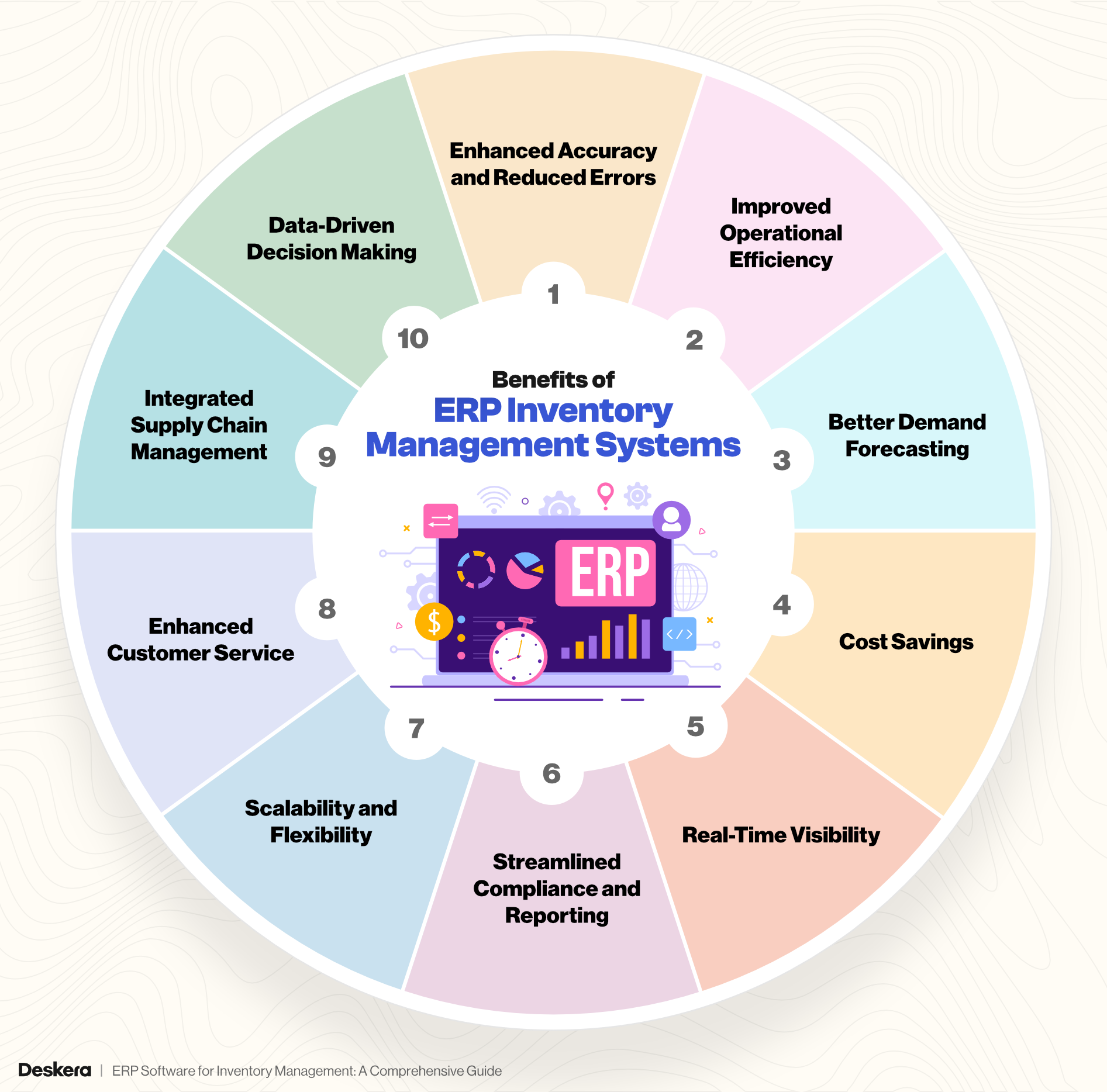
5. Benefits of Implementing ERP for Inventory Management
The strategic implementation of ERP for inventory management yields a multitude of benefits that directly impact a company’s bottom line and competitive advantage.
5.1. Reduced Inventory Costs
- Lower Carrying Costs: By optimizing stock levels, businesses reduce expenses related to storage, insurance, security, and obsolescence.
- Minimized Obsolescence: Accurate forecasting and real-time tracking help identify slow-moving or obsolete items early, allowing for timely liquidation.
- Optimized Purchasing: Better demand forecasting and supplier management lead to more strategic purchasing, potentially leveraging bulk discounts without overstocking.
5.2. Improved Efficiency and Productivity
- Automated Processes: Eliminating manual data entry and repetitive tasks frees up staff to focus on more strategic activities.
- Streamlined Workflows: Integrated processes from procurement to sales order fulfillment reduce bottlenecks and improve operational flow.
- Faster Inventory Turns: More efficient management means inventory moves through the supply chain more quickly.
5.3. Enhanced Accuracy and Data Integrity
- Single Source of Truth: Centralized data eliminates discrepancies and ensures all departments work with consistent, accurate information.
- Reduced Errors: Automation and barcode/RFID scanning significantly minimize human errors associated with manual data entry.
5.4. Better Customer Satisfaction
- Fewer Stockouts: Accurate stock visibility and forecasting prevent stockouts, ensuring products are available when customers want them.
- Faster Order Fulfillment: Streamlined processes lead to quicker picking, packing, and shipping, improving delivery times.
- Improved Communication: Sales teams can provide accurate delivery estimates, enhancing customer trust.
5.5. Optimized Cash Flow
By reducing excess inventory and improving inventory turnover, businesses free up working capital that can be reinvested elsewhere.
5.6. Improved Decision Making
Access to real-time data and comprehensive analytics empowers managers to make informed, data-driven decisions regarding purchasing, pricing, promotions, and supply chain strategies.
5.7. Scalability
ERP systems are designed to scale with a business’s growth, accommodating increased transaction volumes, new product lines, and additional locations without requiring a complete overhaul of the inventory system.
5.8. Regulatory Compliance and Audit Trails
ERP systems maintain detailed records of all inventory movements and transactions, providing robust audit trails essential for regulatory compliance and financial audits.
6. Challenges and Considerations in ERP Implementation
While the benefits are substantial, implementing an ERP system for inventory management is a significant undertaking that comes with its own set of challenges.
- Cost: ERP systems, especially comprehensive ones, represent a substantial investment in terms of software licenses, implementation services, hardware, and ongoing maintenance.
- Complexity: ERP projects are complex, requiring careful planning, configuration, and integration with existing systems.
- Data Migration: Transferring historical inventory data from old systems to the new ERP can be a challenging and time-consuming process, requiring meticulous data cleansing.
- User Adoption and Training: Resistance to change is common. Adequate training and change management strategies are crucial to ensure users embrace the new system.
- Customization vs. Standard Features: While ERPs offer extensive customization, over-customization can lead to higher costs, slower upgrades, and increased complexity. Businesses must balance unique needs with standard best practices.
- Vendor Selection: Choosing the right ERP vendor and solution that aligns with the business’s specific industry, size, and future growth plans is paramount.
- Implementation Time: ERP projects can take months or even years to fully implement, during which business operations must continue.
7. Future Trends in ERP for Inventory Management
The landscape of ERP and inventory management is continuously evolving, driven by technological advancements and changing market demands.
- Artificial Intelligence (AI) and Machine Learning (ML): AI/ML algorithms are enhancing demand forecasting capabilities, identifying complex patterns, optimizing inventory levels dynamically, and even predicting potential supply chain disruptions.
- Internet of Things (IoT): IoT devices (e.g., smart shelves, sensors on assets) can provide real-time, granular data on inventory location, temperature, and movement, automating data capture and improving accuracy.
- Blockchain Technology: Blockchain offers enhanced transparency and traceability across the entire supply chain, providing an immutable record of inventory movement from source to customer, particularly valuable for high-value or regulated goods.
- Cloud-based ERP: The shift to cloud-based (SaaS) ERP solutions continues to accelerate, offering greater flexibility, scalability, reduced upfront costs, and easier maintenance compared to on-premise systems.
- Mobile and Wearable Technology: Further integration with mobile devices and wearable tech will empower warehouse workers with hands-free data entry and real-time information access.
- Robotics and Automation: Integration with automated guided vehicles (AGVs) and robotic picking systems within warehouses will further optimize efficiency and reduce manual labor.
8. Conclusion
Inventory management, once viewed as a back-office function, has evolved into a strategic lever for competitive advantage. The complexities of modern supply chains and the demands for efficiency and customer satisfaction necessitate sophisticated tools. ERP software stands at the forefront of this revolution, offering an integrated, data-driven, and real-time approach to inventory control.
By breaking down informational silos, automating processes, and providing unparalleled visibility and analytical capabilities, ERP systems empower businesses to optimize stock levels, reduce costs, enhance operational efficiency, and ultimately, deliver superior customer experiences. While implementation requires careful planning and significant investment, the long-term benefits of an ERP-powered inventory management system are undeniable, positioning businesses for sustainable growth and resilience in an increasingly dynamic global marketplace. For any organization serious about mastering its supply chain and securing its future, embracing ERP for inventory management is not merely an option, but a strategic imperative.