Navigating the Digital Backbone: An In-Depth Look at the World’s Top ERP Vendors
In today’s fast-paced business environment, efficiency, data integration, and strategic decision-making are not just advantages—they are necessities for survival and growth. At the heart of achieving these critical objectives lies Enterprise Resource Planning (ERP) software. An ERP system acts as the central nervous system of a modern enterprise, consolidating disparate functions like finance, HR, manufacturing, supply chain, and customer relations into a single, cohesive platform. By breaking down data silos and automating core processes, ERP empowers businesses to operate more leanly, respond more swiftly to market changes, and gain invaluable insights into their operations.
However, the journey to selecting and implementing the right ERP system is complex. The market is saturated with powerful solutions, each with its unique strengths, target industries, and deployment models. For businesses embarking on this transformative path, understanding the landscape of top ERP vendors is paramount. This article aims to provide an in-depth exploration of the leading global ERP providers, highlighting their core offerings, strategic differentiators, target markets, and the key considerations for businesses evaluating these robust platforms.
What is ERP and Why is it Crucial?
Before diving into the vendors, let’s briefly define ERP and underscore its significance. At its core, ERP is a suite of integrated software applications that an organization can use to manage and integrate the essential parts of its business. Many ERP software applications are critical to companies because they help them implement resource planning by integrating all the processes needed to run their companies with a single system. An ERP system can integrate planning, purchasing, inventory, sales, marketing, finance, human resources, and more.
The critical importance of ERP stems from several key benefits:
- Improved Efficiency: Automates routine tasks, reduces manual data entry, and streamlines workflows across departments.
- Enhanced Data Visibility & Analytics: Provides a single source of truth for all business data, enabling real-time reporting and more accurate analytics for better decision-making.
- Cost Reduction: Optimizes inventory levels, reduces operational overheads, and minimizes administrative costs.
- Better Customer Service: Integrates CRM data, leading to faster order processing, improved delivery times, and more personalized customer interactions.
- Regulatory Compliance & Security: Helps businesses adhere to industry regulations and provides robust security features to protect sensitive data.
- Scalability & Agility: Modern cloud-based ERP systems can scale with business growth and adapt to changing market demands more easily.
The evolution of ERP has seen a significant shift from on-premise deployments to cloud-based (SaaS) models, offering greater flexibility, lower upfront costs, and easier maintenance. Furthermore, the integration of cutting-edge technologies like Artificial Intelligence (AI), Machine Learning (ML), Internet of Things (IoT), and blockchain is transforming ERP into an even more intelligent and predictive tool for future-proofing businesses.
Key Factors in Choosing an ERP System
Selecting an ERP system is a strategic decision that can impact every facet of an organization. Businesses must consider several critical factors:
- Industry Fit: Does the ERP offer specific functionalities or modules tailored to the unique requirements of your industry (e.g., manufacturing, retail, healthcare, services)?
- Scalability: Can the system grow with your business, accommodating increased users, data volumes, and expanding operations without requiring a complete overhaul?
- Deployment Model: Cloud (SaaS), on-premise, or hybrid? Cloud offers flexibility and lower infrastructure costs, while on-premise provides more control over data and customization.
- Total Cost of Ownership (TCO): Beyond licensing fees, consider implementation costs, customization, training, ongoing maintenance, and potential upgrade expenses.
- Integration Capabilities: How well does the ERP integrate with existing systems (e.g., CRM, e-commerce platforms, specialized industry software) and future technologies?
- User Experience (UX): An intuitive, user-friendly interface is crucial for adoption and productivity. Poor UX can lead to resistance and inefficient use.
- Vendor Support & Ecosystem: Evaluate the vendor’s support services, community resources, partner network, and commitment to ongoing innovation.
- Future-Proofing: Does the system embrace emerging technologies like AI, ML, and advanced analytics to provide a competitive edge in the long run?
The Top ERP Vendors: An In-Depth Analysis
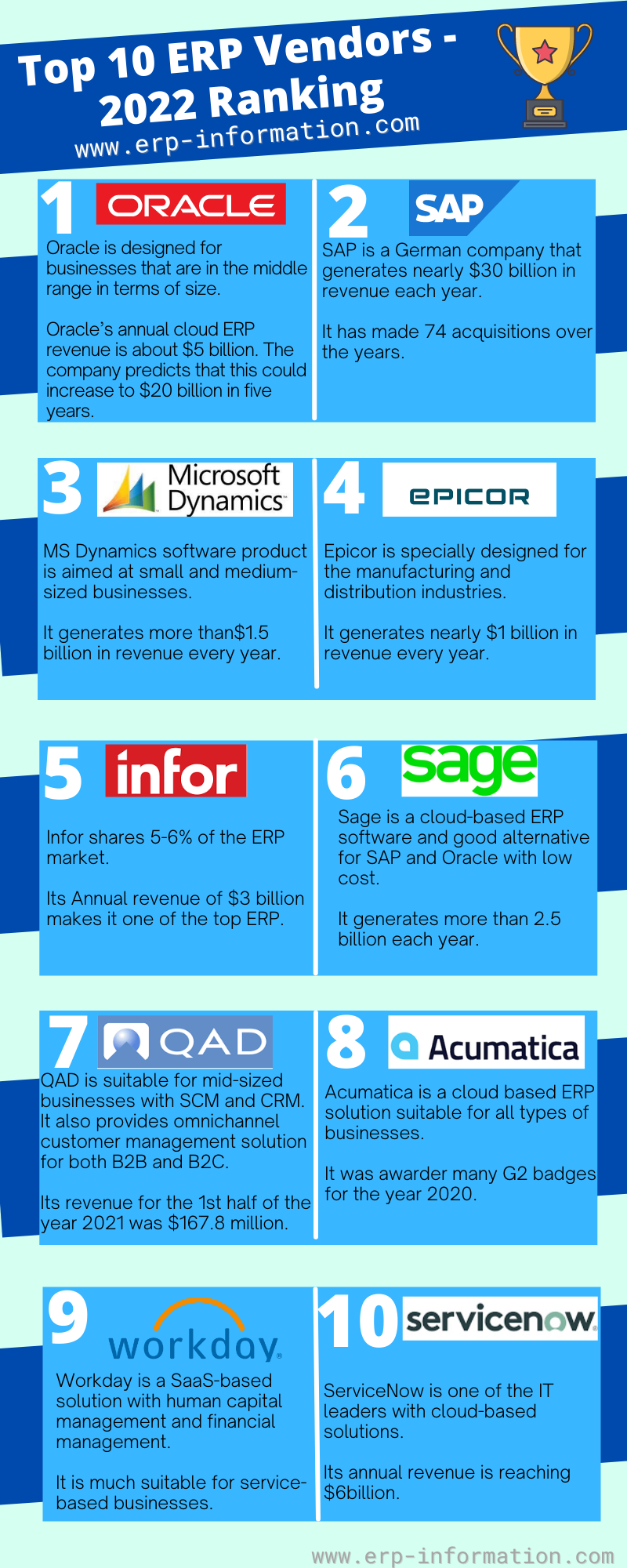
The global ERP market is dominated by a few giants, alongside specialized providers catering to niche markets. Here’s a closer look at the leading players:
1. SAP
Overview:
SAP (Systeme, Anwendungen und Produkte in der Datenverarbeitung) is a German multinational software corporation renowned for its enterprise software to manage business operations and customer relations. As the undisputed leader in the ERP market for decades, SAP serves over 400,000 customers in more than 180 countries, ranging from small businesses to 99 of the 100 largest companies worldwide. Its strength lies in its comprehensive suite of modules, robust functionality, and deep industry-specific solutions.
Key Strengths & Offerings:
SAP’s flagship product, SAP S/4HANA, represents a significant leap forward, built on the revolutionary in-memory HANA database. This allows for real-time processing of massive amounts of data, enabling instant insights and faster decision-making. S/4HANA is available for cloud, on-premise, and hybrid deployments, offering modules for finance, supply chain, manufacturing, procurement, sales, HR, and more. SAP is particularly strong in complex, global enterprises, offering industry-specific versions for nearly every sector, including manufacturing, retail, utilities, public sector, and oil & gas. Their cloud strategy is robust, with SAP S/4HANA Cloud being a fully integrated, modular cloud ERP solution.
Target Market: Large enterprises and multinational corporations with complex operational requirements, often requiring deep customization and extensive international capabilities. They also offer solutions for mid-market companies.
Recent Innovations: Continuous enhancements in AI/ML capabilities embedded within S/4HANA for predictive analytics and automation, advanced analytics, and a strong focus on sustainability management solutions. SAP also heavily invests in its Business Technology Platform (BTP) for extensibility and integration.
2. Oracle
Overview:
Oracle Corporation, an American multinational computer technology company, is the second-largest software company by revenue and a formidable competitor in the ERP space. Leveraging its powerful database technology, Oracle offers a comprehensive suite of cloud-native and on-premise ERP solutions designed for businesses of all sizes. Oracle’s strategy has been to acquire and integrate leading software companies, building a vast portfolio.
Key Strengths & Offerings:
Oracle’s primary cloud offering is Oracle Fusion Cloud ERP, a comprehensive suite that covers financial management, project management, procurement, risk management, and supply chain management. It’s built from the ground up for the cloud, emphasizing AI, machine learning, and a modern user experience. For mid-market and growing businesses, Oracle acquired NetSuite, a pioneering cloud-native ERP solution known for its unified suite covering ERP, CRM, and e-commerce. Oracle also continues to support its legacy on-premise systems like JD Edwards EnterpriseOne and PeopleSoft, catering to existing large enterprise customers. Its database leadership provides a strong foundation for data integrity and performance.
Target Market: Large global enterprises (Oracle Fusion Cloud ERP), mid-market to large enterprises (NetSuite), and organizations with existing Oracle technology investments.
Recent Innovations: Significant investments in embedding AI and ML across its Fusion Cloud applications, autonomous database capabilities, industry-specific solutions within Fusion Cloud, and a strong focus on a complete cloud stack from infrastructure to applications.
3. Microsoft Dynamics 365
Overview:
Microsoft, a global technology behemoth, entered the ERP market with its Dynamics suite, which has evolved into Microsoft Dynamics 365. This offering is a cloud-based suite of intelligent business applications that combine ERP and CRM functionalities, alongside productivity tools from Microsoft 365 and the power of the Azure cloud platform. It offers a highly integrated ecosystem, making it a compelling choice for businesses already invested in Microsoft technologies.
Key Strengths & Offerings:
Dynamics 365 is modular, allowing businesses to select specific applications (e.g., Finance, Supply Chain Management, Commerce, Human Resources, Sales, Customer Service) and scale as needed. Its flagship ERP components are Dynamics 365 Finance and Dynamics 365 Supply Chain Management for larger enterprises, and Dynamics 365 Business Central for small and mid-sized businesses (SMBs). A major differentiator is its seamless integration with other Microsoft products like Office 365, Power BI, Power Apps, and Azure, providing a unified platform for data, analytics, and custom application development.
Target Market: Small to large enterprises, particularly those with a strong reliance on the Microsoft ecosystem and looking for integrated ERP and CRM capabilities.
Recent Innovations: Continuous integration of AI and machine learning for predictive analytics and process automation, leveraging the Power Platform for low-code/no-code customization and extensibility, and enhanced industry-specific functionalities.
4. Infor
Overview:
Infor is an American multinational enterprise software company that provides industry-specific business applications, delivered via the cloud. Infor has carved out a strong niche by focusing on deep industry functionality rather than a one-size-fits-all approach. Acquired by Koch Industries, Infor has seen significant investment in its cloud strategy and user experience.
Key Strengths & Offerings:
Infor’s core offering revolves around its CloudSuites, which are purpose-built for specific industries such as manufacturing, distribution, healthcare, public sector, and retail. These CloudSuites leverage AWS infrastructure and are designed to deliver relevant functionality out-of-the-box, reducing the need for extensive customization. Infor is also known for its modern and intuitive user interface, Hook & Loop, which significantly enhances user adoption. Their solutions cover financials, human capital management, supply chain management, and enterprise asset management.
Target Market: Mid-market to large enterprises within specific industries (e.g., discrete and process manufacturing, fashion, food & beverage, automotive, healthcare).
Recent Innovations: Continued development of industry-specific functionalities within its CloudSuites, enhanced AI/ML capabilities (Infor Coleman AI), and robust integration with IoT devices to provide deeper operational insights.
5. Workday
Overview:
Workday is a leading provider of enterprise cloud applications for finance and human resources. Unlike many traditional ERP vendors that started with broader ERP functionalities, Workday was built from the ground up in the cloud with a strong focus on Human Capital Management (HCM) and Financial Management. This cloud-native approach has given them an edge in agility and user experience.
Key Strengths & Offerings:
Workday’s flagship products are Workday Human Capital Management (HCM) and Workday Financial Management. Workday HCM is widely recognized as a market leader, offering a comprehensive suite for HR, payroll, talent management, and workforce planning. Workday Financial Management provides robust capabilities for accounting, planning, procurement, and financial reporting. Both are known for their modern, intuitive user interface, real-time analytics, and strong emphasis on user engagement and employee experience. Workday operates on a single codebase, ensuring all customers are on the latest version.
Target Market: Large and medium-sized enterprises, particularly those prioritizing human capital management and financial planning with a cloud-first strategy.
Recent Innovations: Continued expansion of planning and analytics capabilities, integration of machine learning for personalized experiences and predictive insights, and a focus on expanding their ecosystem through partnerships.
6. Sage
Overview:
Sage Group plc is a British multinational enterprise software company, the third-largest supplier of enterprise resource planning software worldwide (behind Oracle and SAP). Sage primarily focuses on providing solutions for small and medium-sized businesses (SMBs), offering a range of accounting, payroll, and ERP software.
Key Strengths & Offerings:
Sage offers a diverse portfolio of products tailored to different SMB needs. Sage 100 and Sage 300 are popular ERP solutions for small to mid-sized businesses, providing core accounting, inventory, and sales functionalities. Sage X3 (now Sage Business Cloud Enterprise Management) is designed for larger SMBs and mid-market companies, offering more extensive capabilities for manufacturing, distribution, and services. Sage’s strength lies in its ease of use, strong local support, and a comprehensive ecosystem of add-ons and integrations. Their cloud offerings are increasingly robust, providing flexibility and accessibility.
Target Market: Small and medium-sized businesses (SMBs), often those growing out of basic accounting software and needing more integrated ERP capabilities.
Recent Innovations: Increased investment in cloud-native solutions, enhanced integration capabilities, and embedding AI-driven insights to help SMBs automate tasks and make smarter decisions.
7. Epicor
Overview:
Epicor Software Corporation is an American software company that provides ERP software for manufacturing, distribution, retail, and services industries. Epicor has built a strong reputation for delivering deep industry-specific functionalities, particularly in manufacturing, making it a preferred choice for companies with complex production and supply chain needs.
Key Strengths & Offerings:
Epicor’s flagship ERP product, Epicor Kinetic (formerly Epicor ERP), is designed to handle the intricate processes of modern manufacturers and distributors. It offers modules for production management, supply chain management, financial management, sales, human capital management, and customer relationship management. Epicor is known for its flexibility in deployment (cloud, on-premise, or hybrid) and its ability to support highly customized manufacturing processes. Its industry focus means less customization is often required out-of-the-box for its target audience.
Target Market: Small to large businesses within manufacturing (discrete, process, mixed-mode), distribution, retail, and field service industries.
Recent Innovations: Focus on cloud delivery (Kinetic being cloud-first), enhanced user experience, integration of IoT for real-time operational data, and leveraging AI/ML for predictive maintenance and demand forecasting within manufacturing contexts.
Emerging Trends in ERP
The ERP landscape is continuously evolving, driven by technological advancements and changing business demands. Key emerging trends include:
- AI and Machine Learning Integration: ERP systems are increasingly embedding AI and ML for predictive analytics, intelligent automation (e.g., invoice processing, demand forecasting), personalized user experiences, and anomaly detection.
- Hyper-automation: Combining RPA (Robotic Process Automation) with AI, ML, and other technologies to automate end-to-end business processes, reducing human intervention.
- Composability/Modular ERP: Moving away from monolithic suites towards a more modular, "composable" architecture where businesses can assemble best-of-breed components and integrate them seamlessly, offering greater flexibility and agility.
- Low-Code/No-Code Platforms: Empowering business users to customize and extend ERP functionalities without extensive coding knowledge, accelerating innovation and reducing reliance on IT departments.
- Sustainability Features: ERP vendors are incorporating tools for tracking environmental impact, supply chain ethics, and compliance with sustainability regulations.
- Enhanced User Experience (UX): Modern ERP systems prioritize intuitive, consumer-grade interfaces, mobile accessibility, and personalized dashboards to boost user adoption and productivity.
- Data Security and Compliance: With increasing cyber threats and stricter data privacy regulations (e.g., GDPR, CCPA), ERP systems are bolstering their security features and compliance frameworks.
Conclusion
The selection of an ERP system is one of the most significant strategic decisions a business can make. It’s a journey that requires careful planning, thorough research, and a clear understanding of both the organization’s current needs and its future aspirations. While SAP, Oracle, and Microsoft Dynamics lead the pack with their comprehensive offerings and global reach, specialized vendors like Infor, Workday, Sage, and Epicor provide compelling solutions for specific industries or business sizes.
There is no "one-size-fits-all" ERP solution. The ideal choice depends on a multitude of factors, including industry vertical, company size, budget, existing technology infrastructure, growth strategy, and the desired level of customization. Businesses must engage in a rigorous evaluation process, conduct proof-of-concept tests, and involve key stakeholders from across departments to ensure the chosen system truly aligns with their operational requirements and strategic objectives.
Ultimately, a well-implemented ERP system is more than just software; it’s a strategic asset that can transform business operations, drive efficiency, foster innovation, and provide the competitive edge necessary to thrive in the digital age. By understanding the strengths and nuances of the world’s top ERP vendors, businesses can make an informed decision that paves the way for sustainable growth and success.